
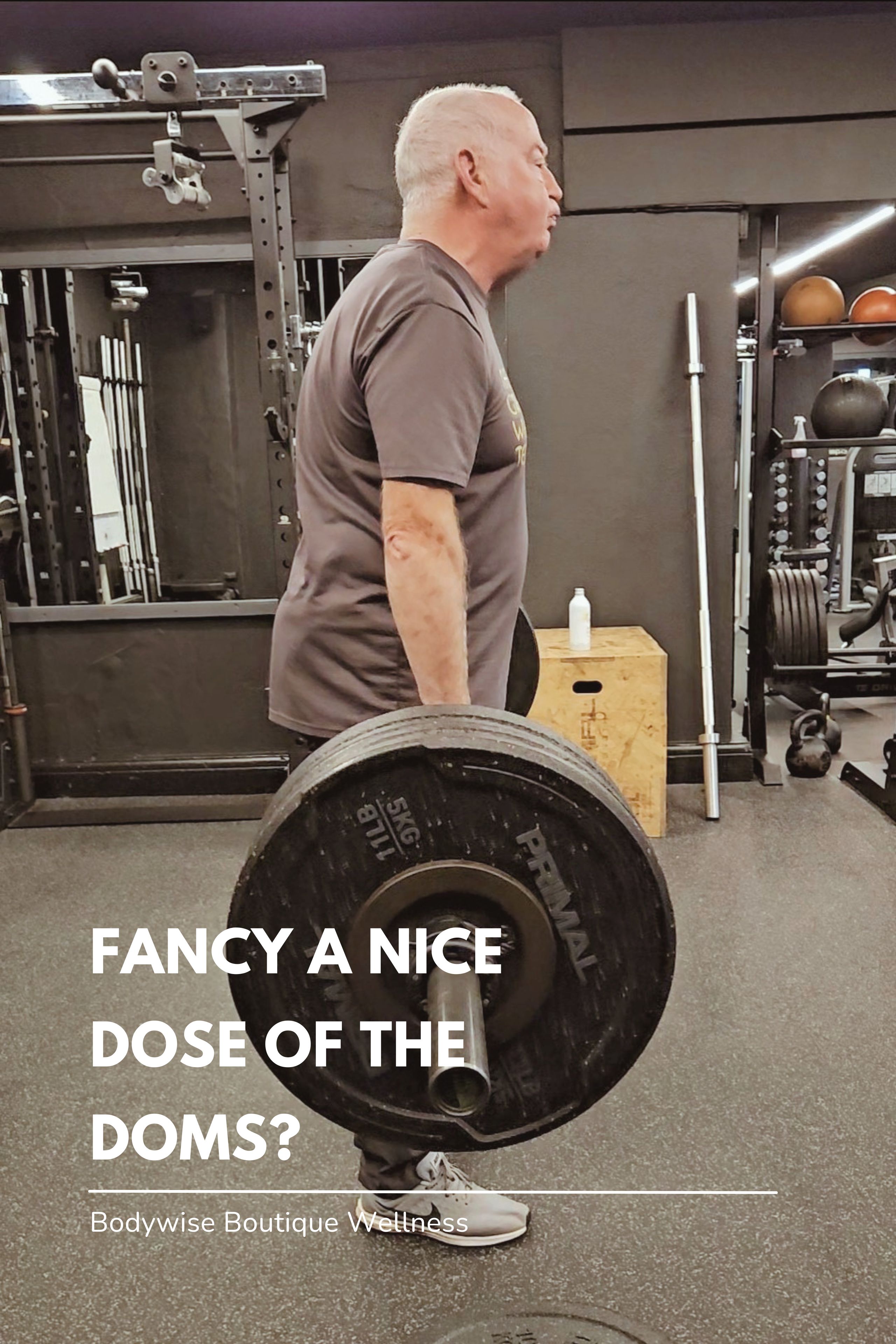
Come to Bodywise for any sort of resistance training session and chances are you’re going to get a ‘dose of the DOMS’. Actually if you don’t it’s fair to say you probably haven’t put enough effort into it – DOMS stands for ‘delayed onset muscle soreness’. We’re talking about muscle pain or discomfort that doesn’t start until 24-48 hours after the work out.
IT’S NOT AN INJURY – IT’S A MUSCLE BUILDING THING
Many people mistake the soreness for having injured themselves. That’s a big ‘Wrong’. DOMS is caused by microscopic tears in muscle fibres and connective tissues that occur during intense or unfamiliar exercise when using weights or resistance machines. This is one of the main processes in strength training – these nano-tears quickly heal and the muscle bounces back and grows. Muscle injury is much quicker to present as an immediate sharp or stabbing pain during activity.
NO PAIN, NO GAIN – AND THE LACTIC ACID TEST
But at the same time the damage triggers an inflammatory response as the body repairs and strengthens the muscle. This inflammation triggers the ‘pain’ that promotes the ‘gain’. At the same time the buildup of waste products from high-intensity exercise, such as lactic acid, can contribute to muscle fatigue and soreness. Generally DOMS wears off within 48-72 hours although may last longer.
THE ‘ECCENTRIC’ CAUSES OF DOMS
This bit might sound a bit off centre, but the cause of DOMS is ‘eccentric exercise’. Weirdly that doesn’t mean exercising in a weird or eccentric fashion! Rather eccentric exercise is the method of strength training where muscles generate force while lengthening, typically during the controlled lowering or “negative” phase of a movement. Examples include slowly descending into a squat, lowering a dumbbell in a bicep curl, or walking downhill, which builds muscle strength, enhances hypertrophy, and prevents injuries.
Unlike concentric (shortening) movements, the muscle acts as a brake against gravity or resistance. In technical fitness terms it creates more micro-tears in muscle fibres compared to concentric training, leading to greater muscle hypertrophy and strength gains. It’s highly effective for strengthening tendons, treating tendinopathy, and improving mobility. We’re talking about squats, push-ups, bicep curls and anything else where resistance (weights or bodyweight) has to be unwound slowly.
EXERCISE, DOMS, RECOVER, REPEAT.
If DOMS is the body’s way of saying that we’re doing our strength training properly it’s something we should actively seek to feel. After all it’s that pain that brings pride and a sense of achievement So, if you’re a bit creaky getting out of bed on Sunday morning after what might have seemed a fairly innocuous Small Group PT session on Friday afternoon (and this writer is talking from experience here) then perhaps ‘ouch’ but also ‘happy days’. Which leaves the muscle burning question – what’s the best way to recover so we can start all over again?
While there is no silver bullet, relief can be found through gentle, active recovery (walking, light exercise), hydration, massage, and occasionally, warm baths with Epsom salts. In moderation a couple of paracetamol don’t do any harm. But really the best thing is to get back into the Bodywise gym – if your legs are suffering get on one of the bikes, or a treadmill, and take things easily. For upper body DOMS do a circuit on the resistance machines at reasonably high reps but low weights.
THE STATUS QUO BETWEEN STRENGTH AND FITNESS
In planning your workout programme with your Bodywise coach it’s important to understand the relationship between strength and fitness. Strength is the maximum force your muscles can exert against resistance (e.g., lifting heavy), focusing on power and muscle, while fitness is a holistic term encompassing cardiovascular endurance, flexibility, and overall physical capacity to play a sport or perform day-to-day tasks efficiently.
It’s quite possible to be strong but not fit, or fit but not strong, or both fit and strong. So you may be able to play three sets of tennis but not lift very much. Or ‘lift heavy’ but be knackered after playing just a few points. As in life strength, conditioning and fitness are a matter of balance – you need the programme that best suits you.
THE OLD AGE DOMS CONUNDRUM
However science shows that weight training is essential as we age to counteract sarcopenia (age-related muscle loss), which begins in our 30s and accelerates after 60. Resistance works boosts metabolism, strengthens bones to prevent osteoporosis, improves mobility, enhances balance to reduce fall risks, and preserves independence, helping to maintain daily functional capacity.
So if you’re coming back, or even newly starting, lifting and strength training at a more mature life stage then DOMS is pretty inevitable. Every sessions you’ll try and lift more so post-session those nano-tears in your muscle tissue are going to react the same way. There are two things to know here. On the one hand research suggests that older adults don’t suffer so much from DOMS as younger adults. On the other hand it takes older adults longer to recover.
It’s also important to realise that age-related changes in connective tissue and reduced muscle mass can make the same level of damage feel more severe, or lead to “aches and pains” that are mistaken for extreme DOMS. Therefore older adults may need to manage training intensity carefully (e.g., 7-9 on a 10-point scale) to gain strength without causing excessive, long-lasting soreness.
EMBRACE DOMS AS A TOTALLY NORMAL PART OF YOUR ROUTINE
If you’re going to ‘do it right’ – and that’s what everybody at Bodywise is there to help you do – then DOMS will become a regular part of your life. It’s an indication that you trained effectively by getting a muscle to recover in a stronger state than it was before you worked out. See DOMS as a positive and remember the mantra – no pain, no gain.
By Al Campbell, The Bodywise Member and Author